Design Ann Criqui
The Must-Have Tools for UX Designers
Get to know the latest UX Designers Must-Have Tools here with mentors, Ann Criqui and Joy Liu!
Ann Criqui8 real product designer resumes from Google, Meta and Instagram hires, by level, plus the patterns they share: one page, metric-led bullets, restraint.

Real product designer resume examples from designers hired at Google, Meta and Instagram share one pattern: one page, metric-led bullets, visual restraint, and a portfolio link at the top. Templates and keyword lists help less than copying those habits from resumes that already cleared a big-tech bar. Below are eight hired examples, mapped by level, plus what changes when you write a senior or lead resume.
These are real product designer resume examples, not templates. Every one of these resumes shares five habits:
The eight designers: Rachel Schmitz (Google), Sanat Rath (Google, later WhatsApp at Meta), Hanna Jung (Google Play, now YouTube), Simon Pan (Google), Maggie Banks (Google Nest), Jessie Van (Google), Jihoon Suh (Meta, now Coinbase), and Min Zhou (Instagram, later OpenSea and Meta Generative AI).
Whether you are breaking into UX design or already a senior IC, steal the patterns below, not the templates.
| Designer | Level on the resume shown | Hired at | What to copy |
|---|---|---|---|
| Maggie Banks | Early-career / intern-era | Google Nest | Zero decoration; awards and GPA do the talking |
| Min Zhou | Early-career / intern-era | Instagram / Facebook | Treat hackathon projects like jobs, with dates and outcomes |
| Rachel Schmitz | Mid | Dedicated Achievements sidebar for shipping results | |
| Sanat Rath | Mid | Skills grouped into named categories | |
| Jessie Van | Mid | Short point-of-view Profile, curated tool list | |
| Simon Pan | Mid | Every bullet a measured outcome under "Experience & Impact" | |
| Hanna Jung | Senior / lead | Google Play | Dense but hierarchical: methods rail + chronological main column |
| Jihoon Suh | Senior / lead | Meta | Quiet accent rail; publications as credibility |
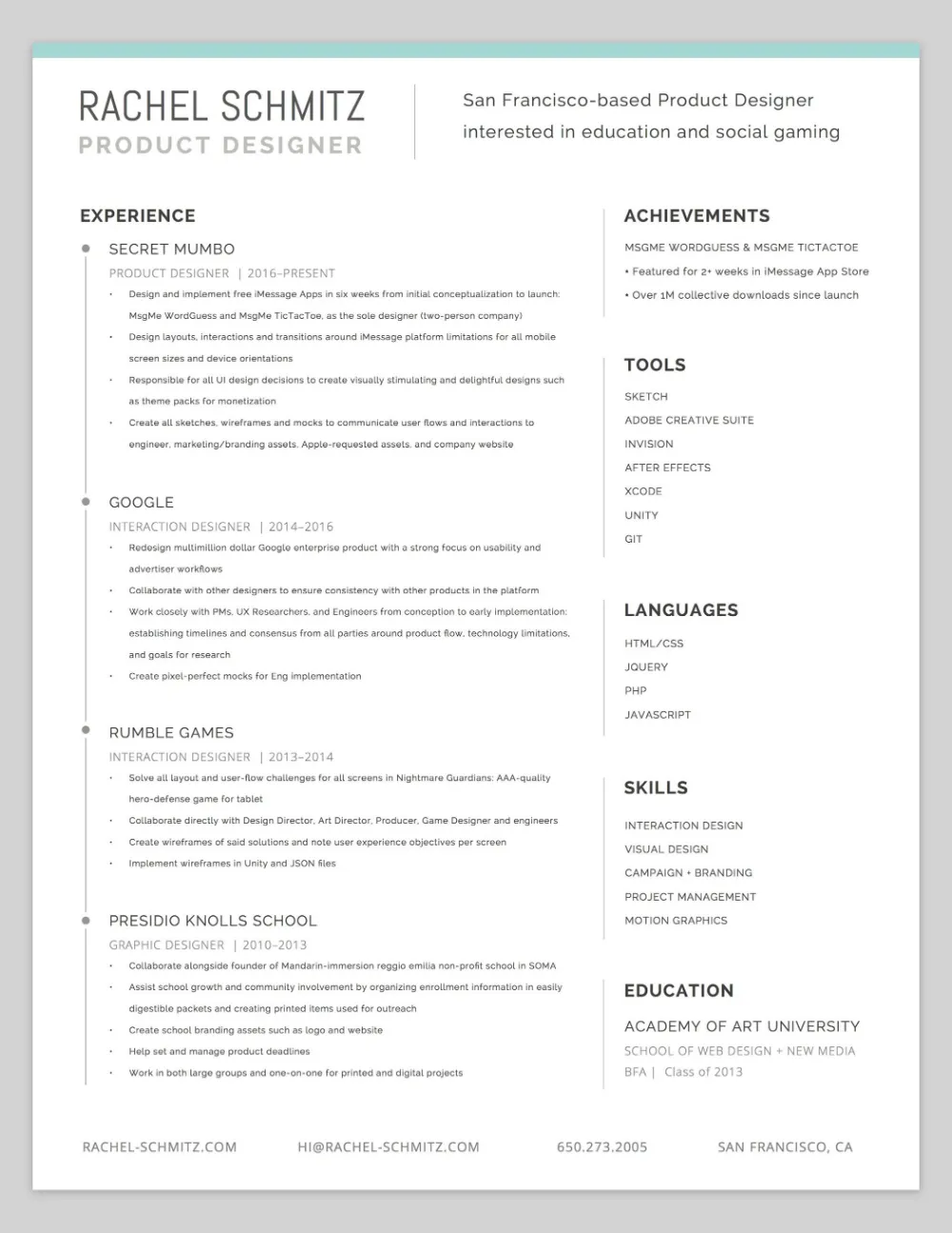
Source: Rachel Schmitz
Rachel spent two years as an interaction designer at Google, then designed iMessage games at Secret Mumbo and went on to lead design at Codi.
Steal this: the dedicated "Achievements" sidebar. Shipping results like "over 1M collective downloads" get their own block instead of drowning inside job bullets.
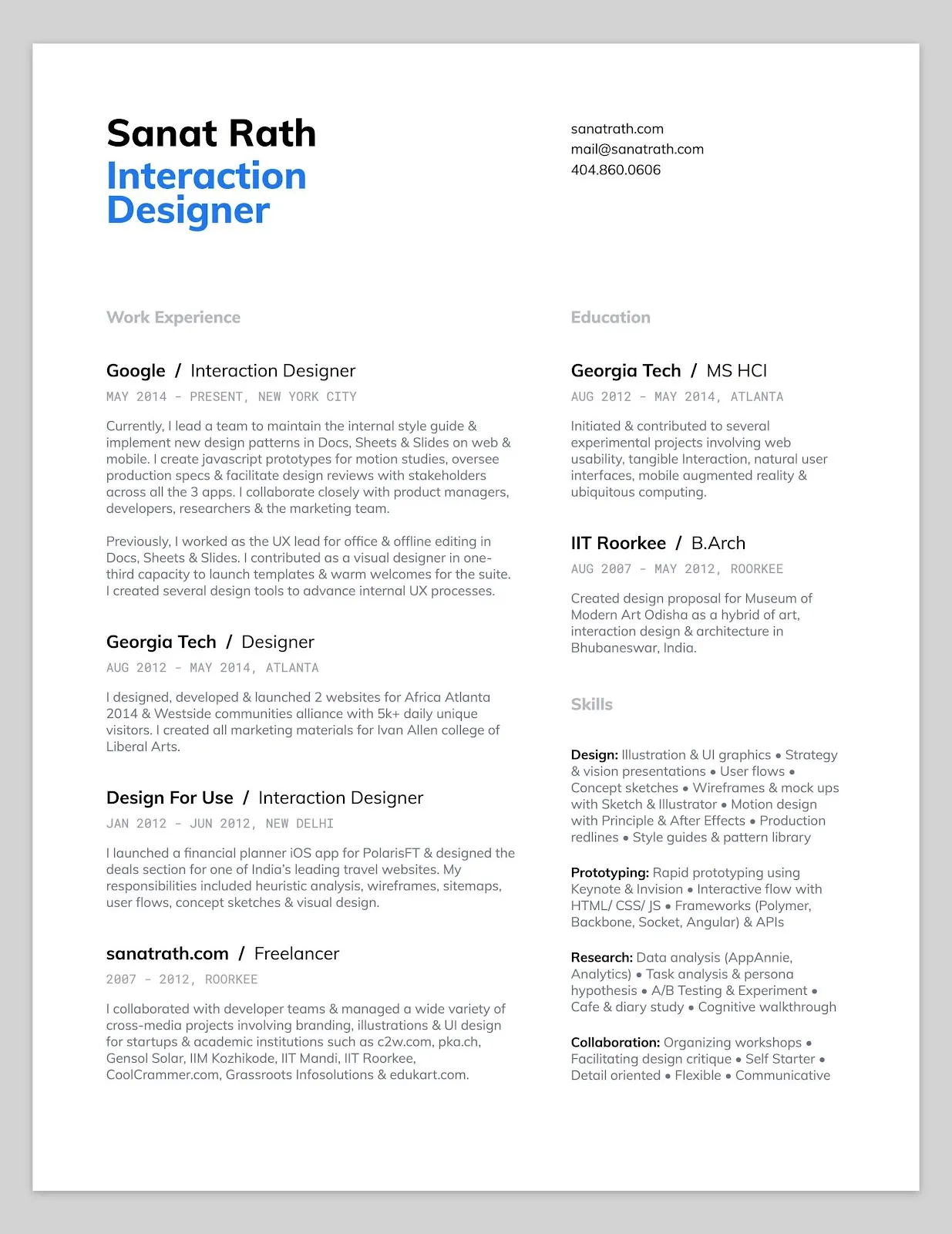
Source: Bestfolios
Sanat Rath joined Google in New York as an interaction designer on Docs, Sheets & Slides, where he led work on the suite's internal style guide. He later moved to Meta to design for WhatsApp.
Steal this: skills grouped into named categories (design, prototyping, research, collaboration) instead of one undifferentiated keyword pile, easier for a human to scan and for software to parse.
Source: Bestfolios
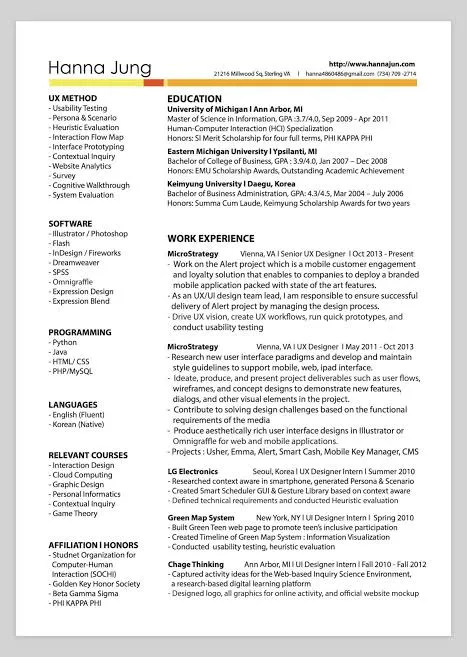
This resume, from Hanna's days as a lead UX designer at MicroStrategy, helped land her a senior UX role on the Google Play team. She is now a staff UX designer at YouTube (checked October 2026).
Steal this: proof that dense can still be scannable. The left rail carries every method and tool; the main column stays chronological. If you have a lot to show, strict hierarchy beats a second page.
Source: Simon Pan
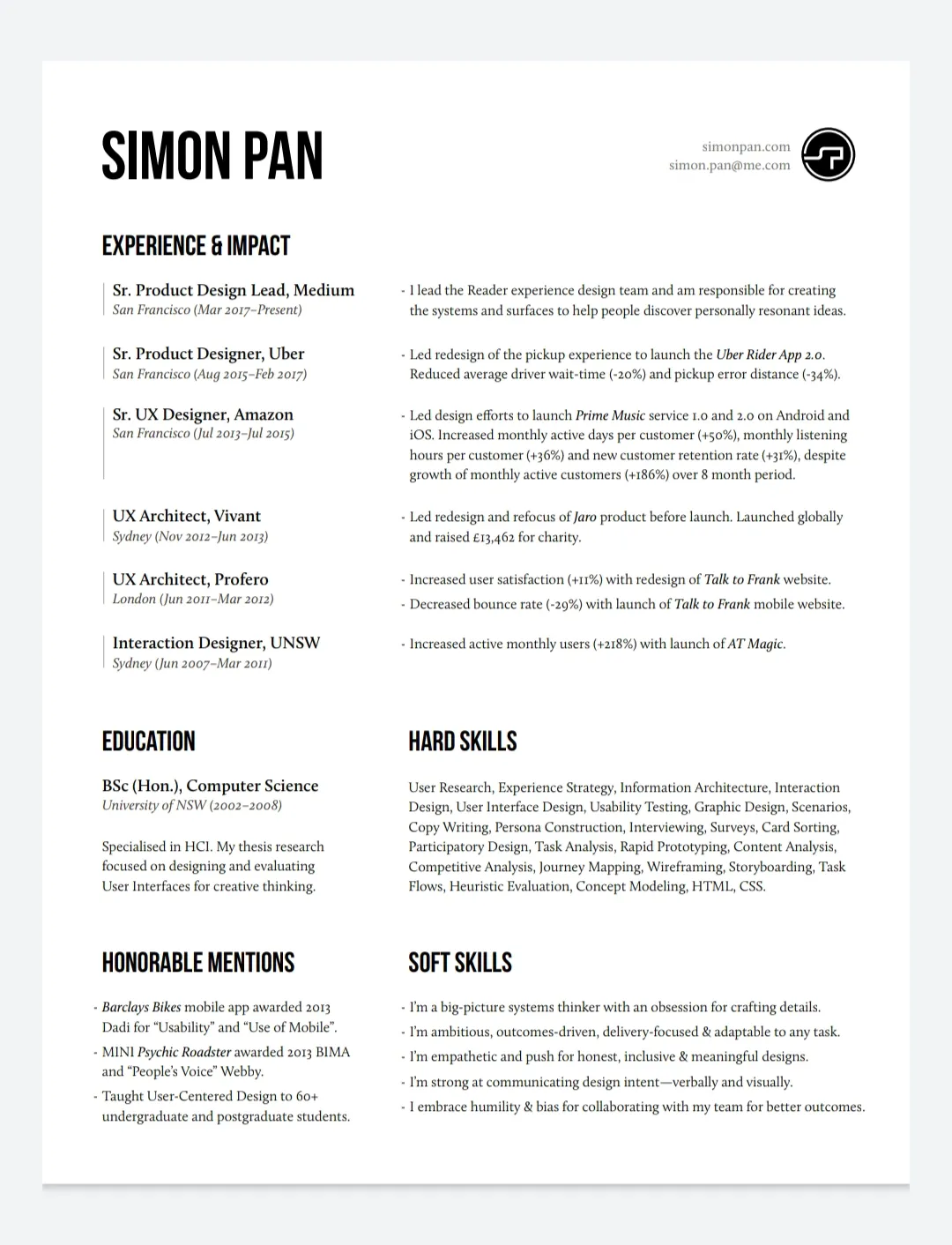
Simon designed at Medium, Uber, and Amazon before joining Google as a product designer in San Francisco.
Steal this: the section is literally titled "Experience & Impact", and every single bullet is a measured outcome: "reduced average driver wait-time (-20%)", "increased monthly active days per customer (+50%)".
Source: Maggie Banks
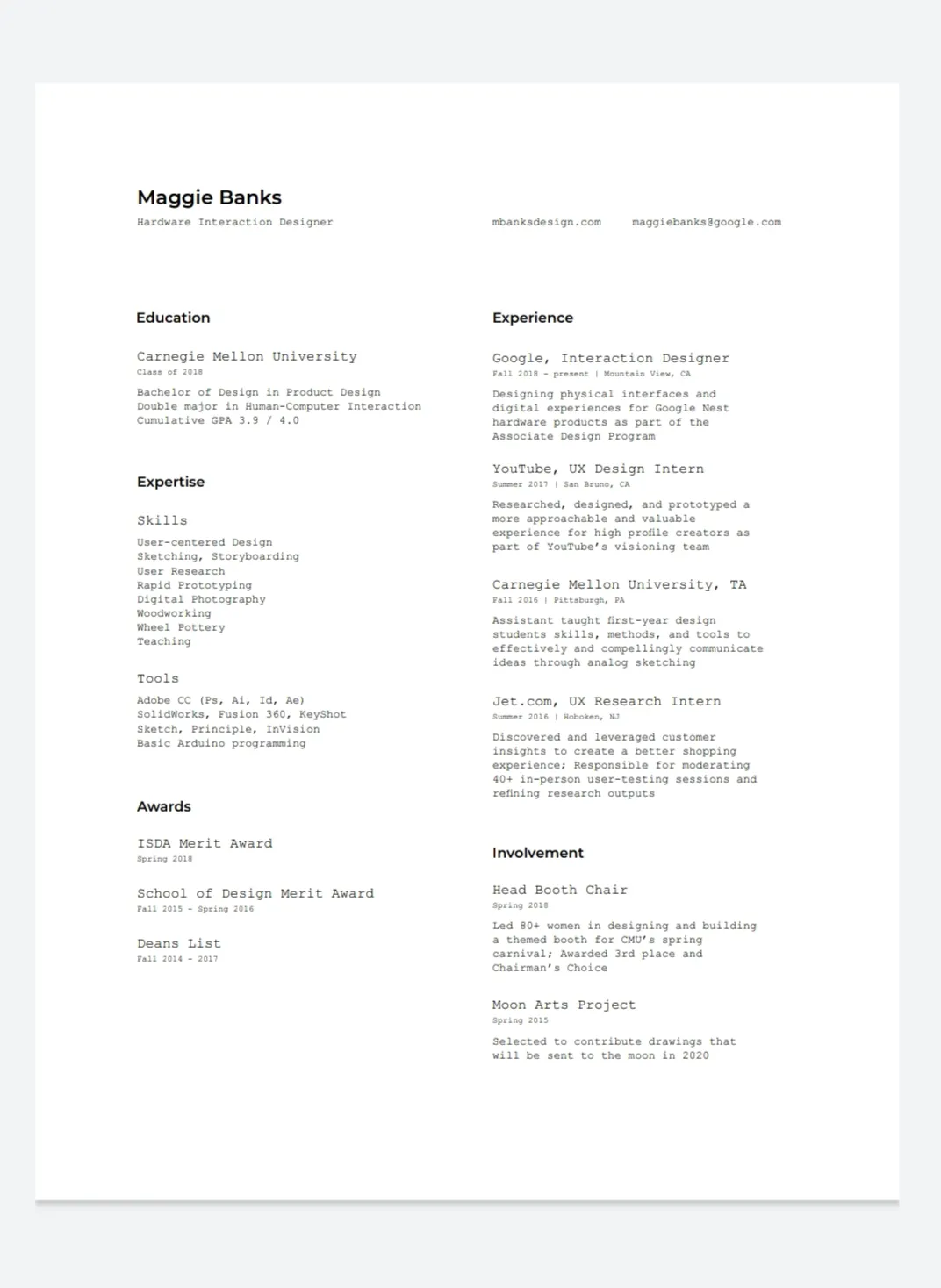
Maggie studied product design and human-computer interaction at Carnegie Mellon, interned at YouTube and Jet.com, and joined Google's hardware design team, where she helped ship Nest Wifi.
Steal this: zero decoration. One typeface, no rules, no icons, no color, and it still reads as designed because the spacing and alignment are exact. A strong early-career move: let the awards and a 3.9 GPA do the talking.
Source: Jessie Van
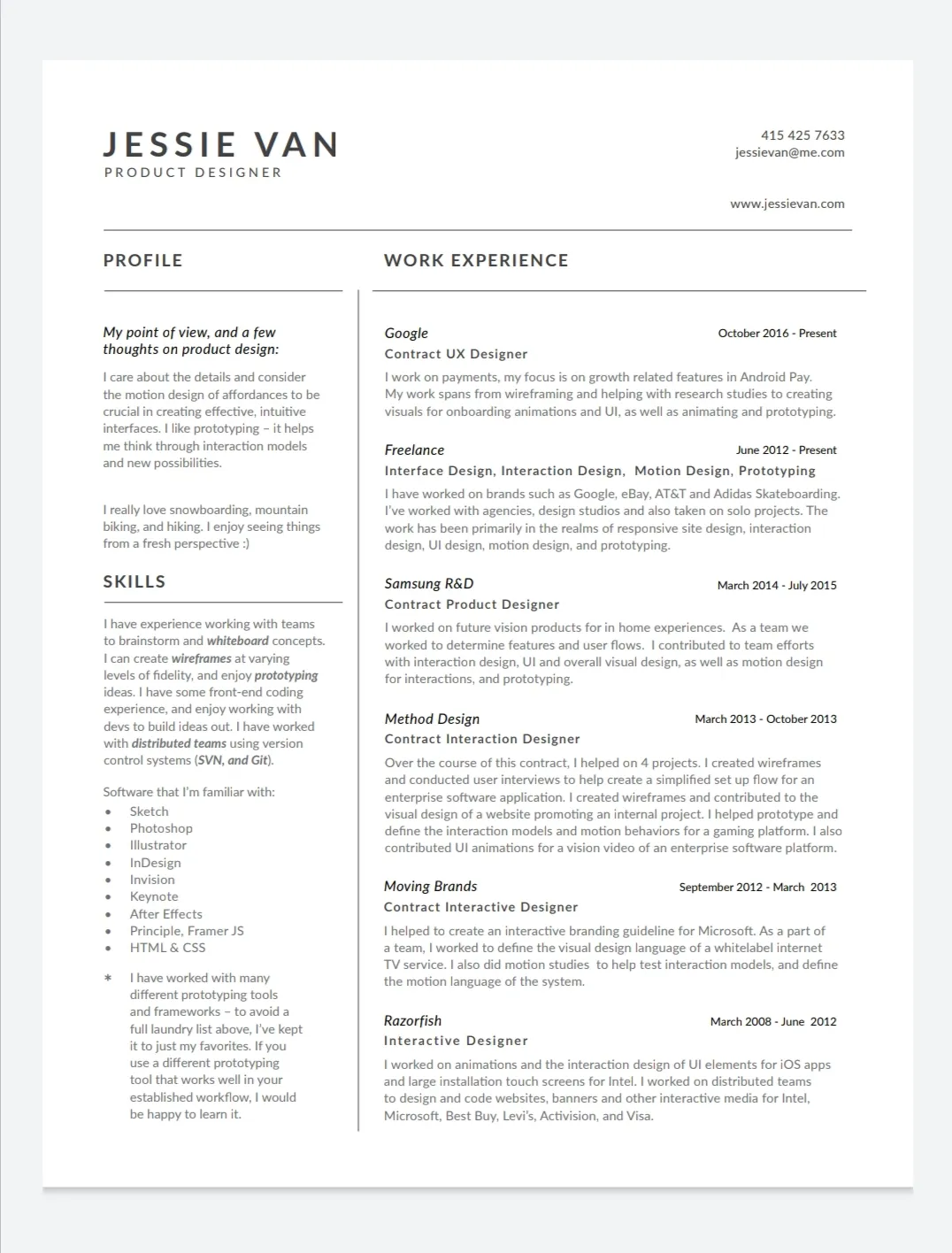
Jessie worked on growth features for Android Pay at Google, after interface and motion design work at Samsung R&D, Method, Moving Brands, and Razorfish.
Steal this: the "Profile" column opens with a genuine point of view on product design, and even admits the tool list is curated ("to avoid a full laundry list… I've kept it to just my favorites"). Personality, deployed precisely.
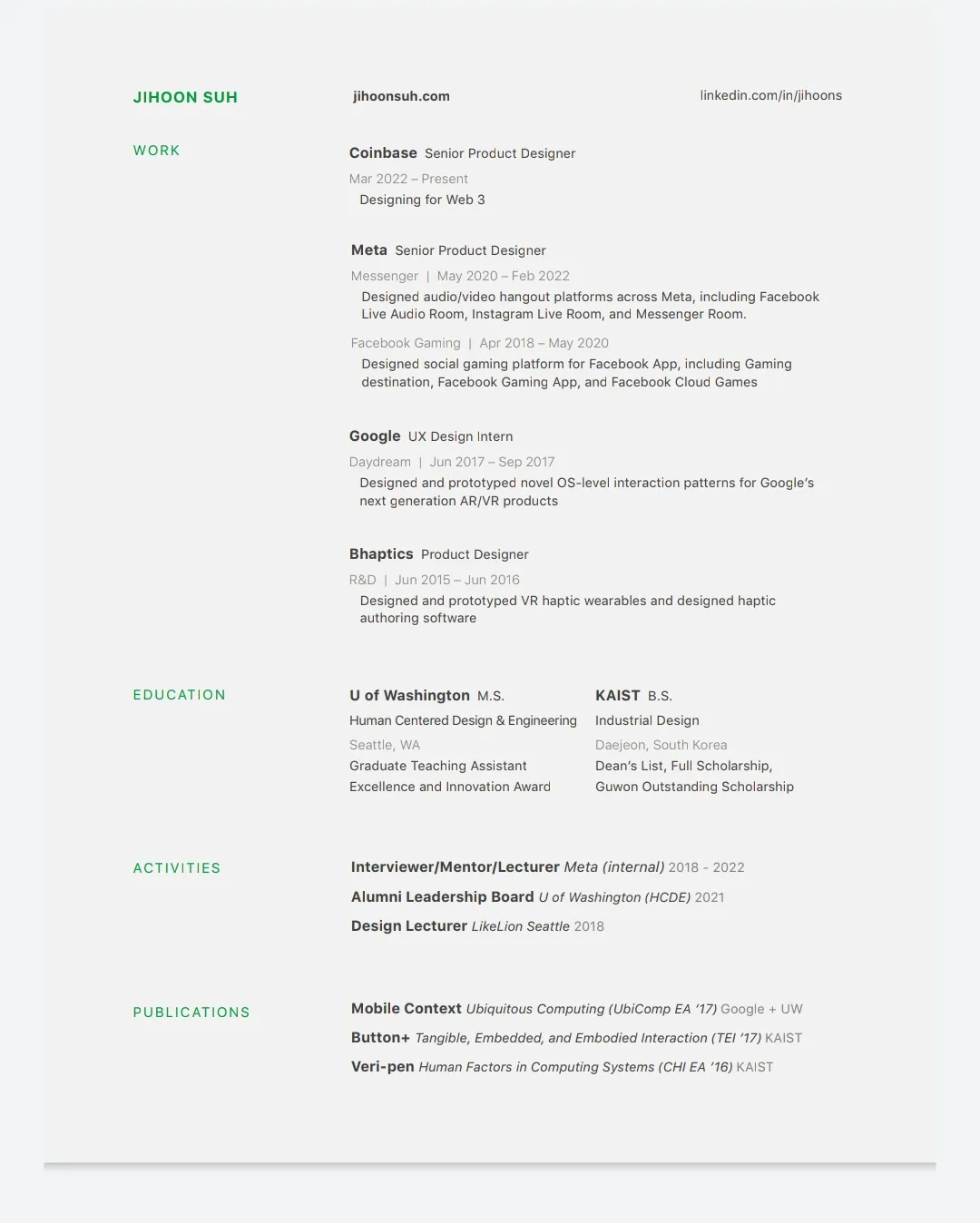
Source: Jihoon Suh
At Meta, Jihoon designed audio and video hangout platforms across Messenger and Instagram, plus Facebook's social gaming products. He is now a design lead at Coinbase (checked October 2026 on his own site).
Steal this: the quiet label rail keeps the whole page to one accent color, and the publications section converts an HCI research background into instant credibility.
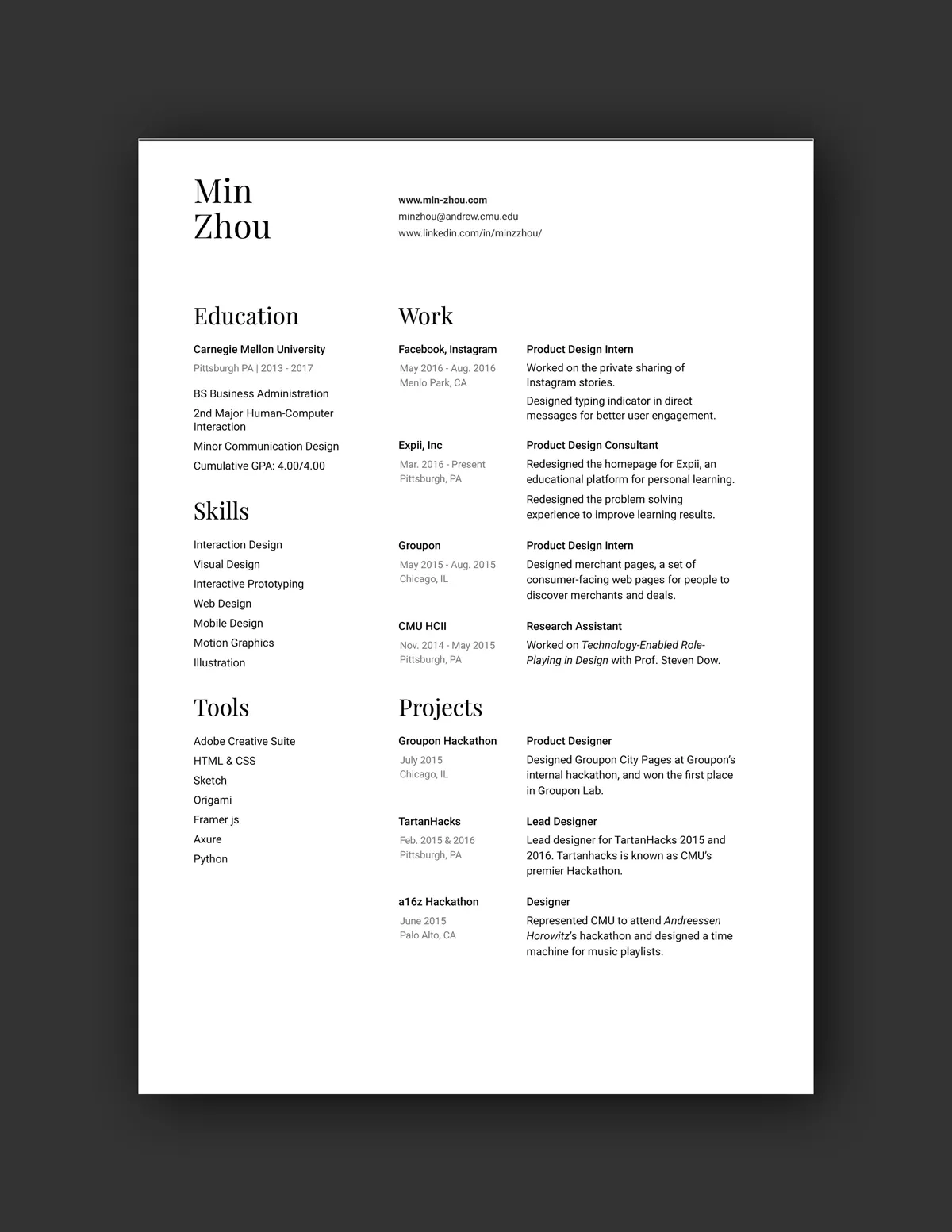
Source: Case Study Club
This is the internship-era resume that got Min Zhou into Facebook and Instagram, where he worked on private sharing for Instagram Stories. He later designed at OpenSea and now works on Meta's Generative AI products (checked October 2026 on minzhou.me).
Steal this: a "Projects" section that treats hackathons like jobs. When you are early in your career, side projects are experience. Give them dates, locations, and outcomes.
At senior and lead level, the one-page rule still holds. What changes is what the bullets prove: scope and leverage, cross-functional work with PMs and engineers, design-system or platform outcomes, and business metrics (retention, wait time, downloads) over tool lists.
Cut the laundry-list of software. Keep the tools the role uses. Borrow what these examples actually show: Simon Pan writes every bullet as a measured outcome, and Jihoon Suh turns HCI publications into a credibility section. If you ship AI product work, name the feature, your role on it, and the measured outcome, in one line. For more on how senior hiring reads portfolios, see our design portfolio examples.
Everybody can write a resume, but not everybody can do it right, and before a human ever sees yours, software usually ranks it. Harvard Business School's Hidden Workers study found that more than 90% of surveyed employers use their recruiting-management software to make the first cut, and 88% admit qualified candidates get filtered out simply because their resumes don't match the job description's exact wording.
Notice what the eight examples above are not: no skill-meter infographics, no headshots, no three-color illustration systems. That restraint is not a coincidence. It reads as taste to a hiring manager and parses cleanly for the machines.
Practical rules that follow:
For a deeper checklist, see our 7 expert tips to build a resume that gets you hired at a Fortune 500 company.
Copying Simon Pan's layout won't get you Simon Pan's interviews. The pattern underneath will: one page, outcomes with numbers, ruthless visual restraint, and a portfolio link that pays off the click. Once the resume starts working, be ready for what comes next with the most-asked Google product design interview questions.
Comparing mentorship options while you revise? See the best mentorship platforms comparison.
One page, one or two typefaces, mostly black and white with at most a single accent color, your name and role title at the top, and a visible portfolio URL. Experience bullets should lead with measurable outcomes ("reduced onboarding drop-off by 20%") rather than duties. In the real resumes that got designers into Google and Meta, the design skill shows in typography and spacing, not decoration.
Yes, in almost every case. All eight resumes in this article, from a college senior to designers with several roles behind them across Medium, Uber, and Amazon, are exactly one page. Recruiters make the first pass in seconds, so ruthless prioritization is itself a design signal. If you have 15+ years and genuinely can't compress, two pages is tolerated but rarely necessary.
The resume comes first mechanically: it is what recruiting software filters and what a recruiter skims to decide whether to open your portfolio at all. But for design roles the portfolio carries far more weight in the actual hiring decision. Treat the resume as the thing that earns the click and the portfolio as the thing that earns the interview, and make sure the portfolio link is impossible to miss on the resume.
ATS-friendly, with restrained, well-crafted typography. Harvard Business School's Hidden Workers study found more than 90% of employers use recruiting software to make the first cut, and 88% acknowledge qualified candidates get filtered out when resumes don't match the job description's wording. Skill meters, headshots, and heavy graphics can break parsing and rarely impress design hiring managers anyway. Save the visual expression for your portfolio.
Evidence of impact: shipped work, metrics tied to your design decisions, the scale of the products you touched, and collaboration with PMs, engineers, and researchers. Named skills grouped by category (design, prototyping, research) help both humans and software find what they need. A strong portfolio link and, for research-leaning roles, publications or teaching add credibility.
In the US, tech employers expect a resume, usually one page for designers; a CV there usually means a longer academic record. In the UK, Europe and much of Asia, 'CV' is the everyday word for the same short document. Send what the posting asks for, keep it to one page, and put the portfolio link at the top.
Scope, cross-team outcomes, measurable product impact, systems or org-level contributions, and a portfolio link. Cut tool lists to what the role uses. If you show AI product work, name the shipped feature, your role, and the measured outcome.
Browse product design mentors on ADPList.
Get to know the latest UX Designers Must-Have Tools here with mentors, Ann Criqui and Joy Liu!
Ann CriquiWhat changes will a collaboration between generative AI and creative work bring to the playing field? We see what we can expect from GenAI.
 Reena Aggarwal
If you're looking to build a website that grabs attention and leaves a lasting impression, read on. We'll show you how to.
 Burkhard Berger
![The Definitive Guide To A Creative Website Design [2023]](https://adplist-bucket.s3.amazonaws.com/media/blog/the-definitive-guide-to-a-creative-website-design-2023-cover.webp)